Attention Is All You Need
Introduction
The Transformer model, introduced in the paper “Attention Is All You Need” by Vaswani et al., revolutionized natural language processing (NLP) by replacing recurrent and convolutional layers with a self-attention mechanism. This architecture enables highly parallel computation and captures long-range dependencies efficiently.
Transformers are widely used in machine translation, text summarization, and other NLP tasks. Their encoder-decoder structure makes them versatile for both sequence-to-sequence and autoregressive tasks.
Architecture Overview
The Transformer consists of two main components:
Encoder: Processes the input sequence and generates contextualized representations.
Decoder: Generates the output sequence, conditioned on the encoder’s representations and previously generated tokens.
Each encoder and decoder block contains:
Multi-Head Self-Attention: Allows each token to attend to all tokens in the sequence.
Feed-Forward Network (FFN): Applies a non-linear transformation to each token’s representation.
Layer Normalization and Residual Connections: Stabilizes training and facilitates gradient flow.
Positional Encoding: Injects sequential information since self-attention lacks inherent order awareness.
Self-Attention Mechanism
The core of the Transformer is the scaled dot-product attention, which computes the attention scores as follows:

where  is the input token representation, and
  are learned weight matrices.
The attention weights are computed using:

This mechanism allows each token to selectively focus on other tokens in the sequence.
Multi-Head Attention
Instead of a single attention function, Transformers use multiple attention heads:

where each head independently performs self-attention. This enhances the model’s ability to capture different aspects of dependencies in the data.
Code Implementation
Below is a PyTorch implementation:
Attention
import copy
import math

import torch
import torch.nn as nn
import torch.nn.functional as F


class LayerNorm(nn.Module):

    def __init__(self, features, eps=1e-6):
        super().__init__()

        self.a_2 = nn.Parameter(torch.ones(features))
        self.b_2 = nn.Parameter(torch.zeros(features))
        self.eps = eps

    def forward(self, x):
        mean = x.mean(-1, keepdim=True)
        std = x.std(-1, keepdim=True)
        return self.a_2 * (x - mean) / (std + self.eps) + self.b_2


def clones(module, n):
    return nn.ModuleList([copy.deepcopy(module) for _ in range(n)])


def attention(query, key, value, mask=None, dropout=None):
    """Scaled Dot Product Attention."""

    d_k = query.size(-1)
    scores = torch.matmul(query, key.transpose(-2, -1)) / (d_k ** 0.5)
    if mask is not None:
        scores = scores.masked_fill(mask == 0, -1e9)
    p_attn = scores.softmax(dim=-1)
    if dropout is not None:
        p_attn = dropout(p_attn)
    return torch.matmul(p_attn, value), p_attn


class MultiHeadedAttention(nn.Module):
    def __init__(self, h, d_model, dropout=0.1):

        super().__init__()

        assert d_model % h == 0

        self.d_k = d_model // h
        self.h = h
        self.linears = clones(nn.Linear(d_model, d_model), 4)
        self.attn = None
        self.dropout = nn.Dropout(p=dropout)

    def forward(self, query, key, value, mask=None):

        if mask is not None:
            mask = mask.unsqueeze(1)
        b = query.size(0)

        query, key, value = [
            lin(x).view(b, -1, self.h, self.d_k).transpose(1, 2)
            for lin, x in zip(self.linears, (query, key, value))
        ]

        x, self.attn = attention(
            query, key, value, mask=mask, dropout=self.dropout
        )

        x = (
            x.transpose(1, 2)
            .contiguous()
            .view(b, -1, self.h * self.d_k)
        )
        del query
        del key
        del value
        return self.linears[-1](x)
PositionWiseFeedForward
class PositionWiseFeedForward(nn.Module):

    def __init__(self, d_model, d_ff, dropout=0.1):
        super().__init__()
        self.w_1 = nn.Linear(d_model, d_ff)
        self.w_2 = nn.Linear(d_ff, d_model)
        self.dropout = nn.Dropout(dropout)

    def forward(self, x):
        return self.w_2(self.dropout(self.w_1(x).relu()))
Positional Encoding
Transformers do not have built-in sequential order awareness, unlike RNNs. Therefore, we need to inject position information explicitly. The positional encoding (PE) helps the model distinguish between different positions in a sequence by assigning unique vectors to each position.
The common approach is to use sinusoidal functions:


where:
 is the position index in the sequence.
 is the dimension index.
 is the embedding size.
We analyze how  relates to
  . Substituting
  into the PE formula:


Using trigonometric sum identities:


Let 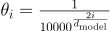 , then:


This transformation can be rewritten as a 2D rotation matrix:

This means that moving from to is equivalent to rotating the positional encoding vector by an angle  , where
  depends on .
class PositionalEncoding(nn.Module):

    def __init__(self, d_model, dropout, max_len=5000):
        super().__init__()
        self.dropout = nn.Dropout(p=dropout)

        pe = torch.zeros(max_len, d_model)
        position = torch.arange(0, max_len).unsqueeze(1)
        div_term = torch.exp(
            torch.arange(0, d_model, 2) * -(math.log(10000.0) / d_model)
        )
        pe[:, 0::2] = torch.sin(position * div_term)
        pe[:, 1::2] = torch.cos(position * div_term)
        pe = pe.unsqueeze(0)
        self.register_buffer("pe", pe)

    def forward(self, x):
        x = x + self.pe[:, : x.size(1)].requires_grad_(False)
        return self.dropout(x)
Encoder Structure
class Encoder(nn.Module):

    def __init__(self, layer, n):
        super().__init__()

        self.layers = clones(layer, n)
        self.norm = LayerNorm(layer.size)

    def forward(self, x, mask=None):

        for layer in self.layers:
            x = layer(x, mask=mask)
        return self.norm(x)


class SublayerConnection(nn.Module):

    def __init__(self, size, dropout):
        super().__init__()

        self.norm = LayerNorm(size)
        self.dropout = nn.Dropout(dropout)

    def forward(self, x, sublayer):

        return x + self.dropout(sublayer(self.norm(x)))


class EncoderLayer(nn.Module):

    def __init__(self, size, self_attn, feed_forward, dropout):
        super().__init__()

        self.self_attn = self_attn
        self.feed_forward = feed_forward
        self.sublayer = clones(SublayerConnection(size, dropout), 2)
        self.size = size

    def forward(self, x, mask):

        x = self.sublayer[0](x, lambda x: self.self_attn(x, x, x, mask))
        return self.sublayer[1](x, self.feed_forward)
Decoder Structure
class Decoder(nn.Module):

    def __init__(self, layer, n):
        super().__init__()

        self.layers = clones(layer, n)
        self.norm = LayerNorm(layer.size)

    def forward(self, x, memory, src_mask, tgt_mask):
        for layer in self.layers:
            x = layer(x, memory, src_mask, tgt_mask)
        return self.norm(x)


class DecoderLayer(nn.Module):

    def __init__(self, size, self_attn, src_attn, feed_forward, dropout):
        super().__init__()

        self.size = size
        self.self_attn = self_attn
        self.src_attn = src_attn
        self.feed_forward = feed_forward
        self.sublayer = clones(SublayerConnection(size, dropout), 3)

    def forward(self, x, memory, src_mask, tgt_mask):

        m = memory
        x = self.sublayer[0](x, lambda x: self.self_attn(x, x, x, tgt_mask))
        x = self.sublayer[1](x, lambda x: self.src_attn(x, m, m, src_mask))
        return self.sublayer[2](x, self.feed_forward)
Encoder-Decoder Structure
import copy

import torch
import torch.nn as nn
import torch.nn.functional as F


class EncoderDecoder(nn.Module):
    """A standard Encoder-Decoder architecture. """

    def __init__(self, encoder, decoder, src_embed, tgt_embed, generator):
        super().__init__()

        self.encoder = encoder
        self.decoder = decoder
        self.src_embed = src_embed
        self.tgt_embed = tgt_embed
        self.generator = generator

    def forward(self, src, tgt, src_mask, tgt_mask):
        return self.decode(self.encode(src, src_mask), src_mask, tgt, tgt_mask)

    def encode(self, src, src_mask):
        return self.encoder(self.src_embed(src), src_mask)

    def decode(self, memory, src_mask, tgt, tgt_mask):
        return self.decoder(self.tgt_embed(tgt), memory, src_mask, tgt_mask)


class Generator(nn.Module):

    def __init__(self, d_model, vocab):
        super().__init__()

        self.proj = nn.Linear(d_model, vocab)

    def forward(self, x):
        return F.log_softmax(self.proj(x), dim=-1)
Transformer
def make_model(src_vocab, tgt_vocab, n=6, d_model=512, d_ff=2048, h=8, dropout=0.1):

    c = copy.deepcopy
    attn = MultiHeadedAttention(h, d_model)
    ff = PositionWiseFeedForward(d_model, d_ff, dropout)
    position = PositionalEncoding(d_model, dropout)
    model = EncoderDecoder(
        Encoder(EncoderLayer(d_model, c(attn), c(ff), dropout), n),
        Decoder(DecoderLayer(d_model, c(attn), c(attn), c(ff), dropout), n),
        nn.Sequential(Embeddings(d_model, src_vocab), c(position)),
        nn.Sequential(Embeddings(d_model, tgt_vocab), c(position)),
        Generator(d_model, tgt_vocab),
    )

    for p in model.parameters():
        if p.dim() > 1:
            nn.init.xavier_uniform_(p)
    return model


def subsequent_mask(size):

    attn_shape = (1, size, size)
    subsequent_mask = torch.triu(torch.ones(attn_shape), diagonal=1).type(
        torch.uint8
    )
    return subsequent_mask == 0


def inference_test():
    test_model = make_model(11, 11, 2)
    test_model.eval()
    src = torch.LongTensor([[1, 2, 3, 4, 5, 6, 7, 8, 9, 10]])
    src_mask = torch.ones(1, 1, 10)

    memory = test_model.encode(src, src_mask)
    ys = torch.zeros(1, 1).type_as(src)

    for i in range(9):
        out = test_model.decode(
            memory, src_mask, ys, subsequent_mask(ys.size(1)).type_as(src.data)
        )
        prob = test_model.generator(out[:, -1])
        _, next_word = torch.max(prob, dim=1)
        next_word = next_word.data[0]
        ys = torch.cat(
            [ys, torch.empty(1, 1).type_as(src.data).fill_(next_word)], dim=1
        )

    print("Example Untrained Model Prediction:", ys)


def run_tests():
    for _ in range(10):
        inference_test()


run_tests()
Conclusion
The Transformer model has become the foundation of modern NLP due to its efficient self-attention mechanism and parallel computation capabilities. By eliminating recurrence, it enables faster training and better captures long-range dependencies. Understanding its architecture is crucial for leveraging state-of-the-art language models like BERT and GPT.