Bayes Theorem
Introduction
Bayes theorem, named after the Reverend Thomas Bayes, is a fundamental concept in probability theory and statistics. It provides a mathematical framework for updating the probability of a hypothesis based on new evidence. This theorem is widely used in various fields, such as machine learning, medical diagnosis, and decision-making under uncertainty.
Mathematical Formulation
Bayes theorem is expressed as:
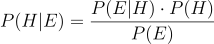
where:
 is the posterior probability: the probability of the hypothesis
  given the evidence
  .
. is the likelihood: the probability of observing the evidence given that is true.
 is the prior probability: the initial probability of the hypothesis before observing the evidence.
 is the marginal probability: the total probability of the evidence under all possible hypotheses.
Proof
Bayes theorem can be derived using the definition of conditional probability. For two events and :

Rearranging this equality gives:
Thus, Bayes theorem is established.
Intuitive Explanation
Bayes theorem allows us to update our belief about a hypothesis when new evidence is introduced. Consider the following analogy:
Hypothesis (
): A bag contains mostly red balls.Evidence (
): You draw a red ball from the bag.
Initially, you may assign a prior probability to the hypothesis based on your knowledge or assumptions. When you observe the evidence (a red ball), you use the likelihood () to update your belief about the hypothesis. The posterior probability () reflects this updated belief.
Key Insights
Dynamic Updating: Bayes theorem provides a dynamic way to revise probabilities as new evidence is introduced.
Interplay of Prior and Evidence: The posterior probability depends on both the prior and the likelihood. Strong prior beliefs can dominate unless the evidence is overwhelming.
Normalization: The marginal probability (
) ensures that the posterior probabilities across all hypotheses sum to 1, maintaining a coherent probability distribution.Applications: From spam email detection to medical testing, Bayes theorem underpins many probabilistic models and inference techniques.
Conclusion
Bayes theorem is a powerful tool for reasoning under uncertainty. By combining prior knowledge with observed evidence, it allows for a rational and systematic update of beliefs. Its significance extends beyond theoretical probability, impacting practical applications across diverse domains.